Chocó Andes Program

The Chocó forests of northwest Ecuador form part of one of the ten most important biodiversity hotspots globally. While the Chocó is almost as diverse as the much better-known Amazon basin, it is far more threatened by rapid deforestation.

The Chocó forests of northwest Ecuador form part of one of the ten most important biodiversity hotspots globally. The Chocó lies between the Andes and the Pacific coast, and stretches from Panama, through Colombia, and into northwest Ecuador. With more than 11,000 species of vascular plants, the Chocó is the floristic hotspot of the Americas. The Ecuadorian Chocó alone supports 900 species of birds, more than 8% of all bird species on Earth. The Chocó even surpasses the Amazon in the number of endemic and range-restricted species. 

While the Chocó is almost as diverse as the much better-known Amazon basin, it is far more threatened by rapid deforestation. The Ecuadorian Chocó was entirely forested in 1938, but by 1988, only 50 years later, 95% of the forests in western Ecuador below 3,000 feet (900 m) had already disappeared. There is a consensus that less than 3% of lowland forests remain now, and deforestation continues.
mapa+choco+program-23

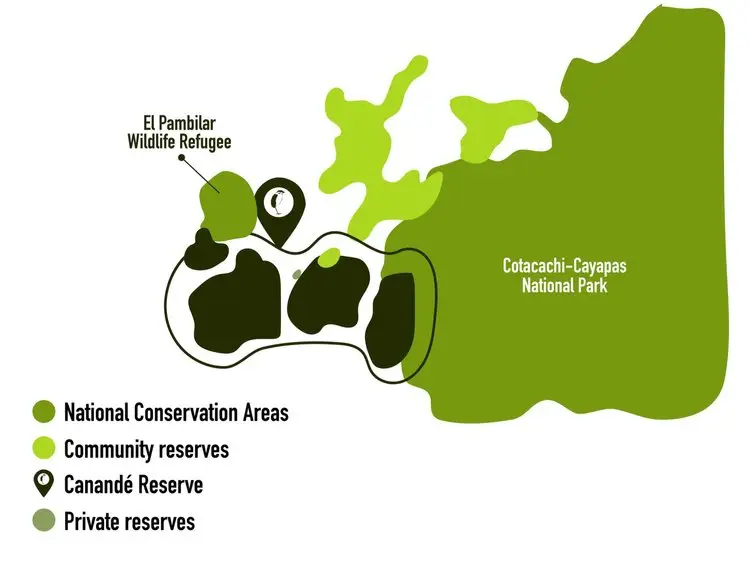
We formulated a response to these threats: create a Ring of Defense by buffering and connecting existing protected areas to form a contiguous conservation network spanning more than 1.2 million acres (500,000 ha). This is the only area in the western tropical Andes where the entire range of ecosystems can be protected from less than 200 feet above sea level to more than 16,000 feet (50-4,900 m) in elevation. Fortunately, we aren’t starting from zero, and more than half of our target is already protected. 

The largest intact wilderness area that remains in the Ecuadorian Chocó is the 645,000-acre (261,000-ha) Cotacachi-Cayapas National Park. Our largest reserve, Canandé, along with indigenous reserves, private reserves, and less strictly protected governmental areas, buffer some of that national park. A series of private reserves, including our Yanacocha Reserve, protect higher elevation Andean forests.

OUR COMMUNITY

Brow headed spider monkey
Researchers from the Chocó Lab
Sachatamia ilex

OUR PROGRAMS

The Chumbes program covers a region where there is a unique blending of wet Chocó ecosystems with Tumbesian and Andean dry forests. Like its ecosystems, the Chumbes name itself is derived from combining the Chocó and Tumbes names together. The Rio Jubones carved a 2,000-meter-deep gorge through the middle of this region, creating a barrier to wildlife. The resulting islands in the sky host unique species that have been isolated for millennia. The pressures from agricultural expansion and mining here are severe.
Thanks to its strategic location, this area is home to a unique variety of plants and animals that combine species from the Andes and the Amazon. Here, we seek to maintain the connectivity of an entire ladder of ecosystems, from the icy Andean peaks to the jungle of the upper Napo, giving species more space to thrive.
The Podocarpus-El Cóndor Biosphere Reserve hosts a very special assembly of Andean ecosystems, humid forests of the El Cóndor mountain range, older than the Andes, and one of the few dry forests of the Amazon basin trapped between both. Nine of these ecosystems are unique as a whole and all of them are home to countless endemic species. At the same time, destruction due to deforestation and mining is still spreading fast, making our conservation job a high priority if we are to prevent the extinction of hundreds of species, many of them still unknown to science.
Located 600 miles off the coast of Ecuador in the Pacific Ocean, the iconic islands are famed for their biodiversity and have been a living laboratory for the study of evolution for nearly two centuries. The islands are close enough to the mainland that plants and animals have managed to find their way to them. The islands are far enough from the mainland and from each other that once plants and animals arrive, they become isolated and evolve into new and unique species.
This site is registered on wpml.org as a development site. Switch to a production site key to remove this banner.