The Podocarpus-El Cóndor Biosphere Reserve hosts a very special assembly of Andean ecosystems, humid forests of the El Cóndor mountain range, older than the Andes, and one of the few dry forests of the Amazon basin trapped between both. Nine of these ecosystems are unique as a whole and all of them are home to countless endemic species. At the same time, destruction due to deforestation and mining is still spreading fast, making our conservation job a high priority if we are to prevent the extinction of hundreds of species, many of them still unknown to science.
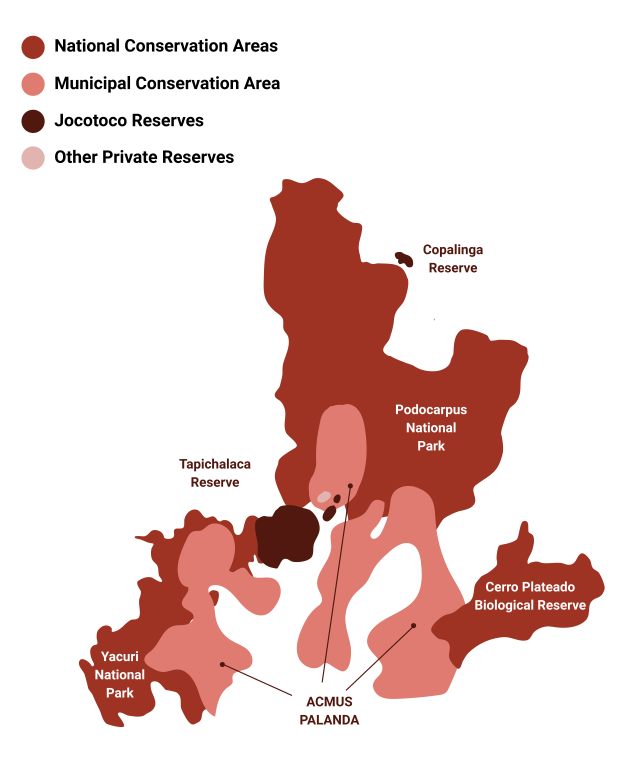
At the heart of this landscape lies the Tapichalaca Reserve, home of the Jocotoco Antpitta and a key joint connecting two national parks. Now, we are working to extend protection beyond this 200,000-hectare network of protected areas by improving the management of a 70,000-hectare large municipal conservation area that further connects with a smaller national reserve. Once we establish an effective management scheme in this 300,000+ core area, we plan to extend actions around our Copalinga Reserve to the north, along El Cóndor to the east, or south to the dry forests of Zumba Valley.
The Chumbes program covers a region where there is a unique blending of wet Chocó ecosystems with Tumbesian and Andean dry forests. Like its ecosystems, the Chumbes name itself is derived from combining the Chocó and Tumbes names together. The Rio Jubones carved a 2,000-meter-deep gorge through the middle of this region, creating a barrier to wildlife. The resulting islands in the sky host unique species that have been isolated for millennia. The pressures from agricultural expansion and mining here are severe.
Thanks to its strategic location, this area is home to a unique variety of plants and animals that combine species from the Andes and the Amazon. Here, we seek to maintain the connectivity of an entire ladder of ecosystems, from the icy Andean peaks to the jungle of the upper Napo, giving species more space to thrive.
Located 600 miles off the coast of Ecuador in the Pacific Ocean, the iconic islands are famed for their biodiversity and have been a living laboratory for the study of evolution for nearly two centuries. The islands are close enough to the mainland that plants and animals have managed to find their way to them. The islands are far enough from the mainland and from each other that once plants and animals arrive, they become isolated and evolve into new and unique species.
The Chocó forests of northwest Ecuador form part of one of the ten most important biodiversity hotspots globally. While the Chocó is almost as diverse as the much better-known Amazon basin, it is far more threatened by rapid deforestation.