Chocó Tumbes Program

The Chumbes program covers a region where there is a unique blending of wet Chocó ecosystems with Tumbesian and Andean dry forests. Like its ecosystems, the Chumbes name itself is derived from combining the Chocó and Tumbes names together. The Rio Jubones carved a 2,000-meter-deep gorge through the middle of this region, creating a barrier to wildlife. The resulting islands in the sky host unique species that have been isolated for millennia. The pressures from agricultural expansion and mining here are severe.
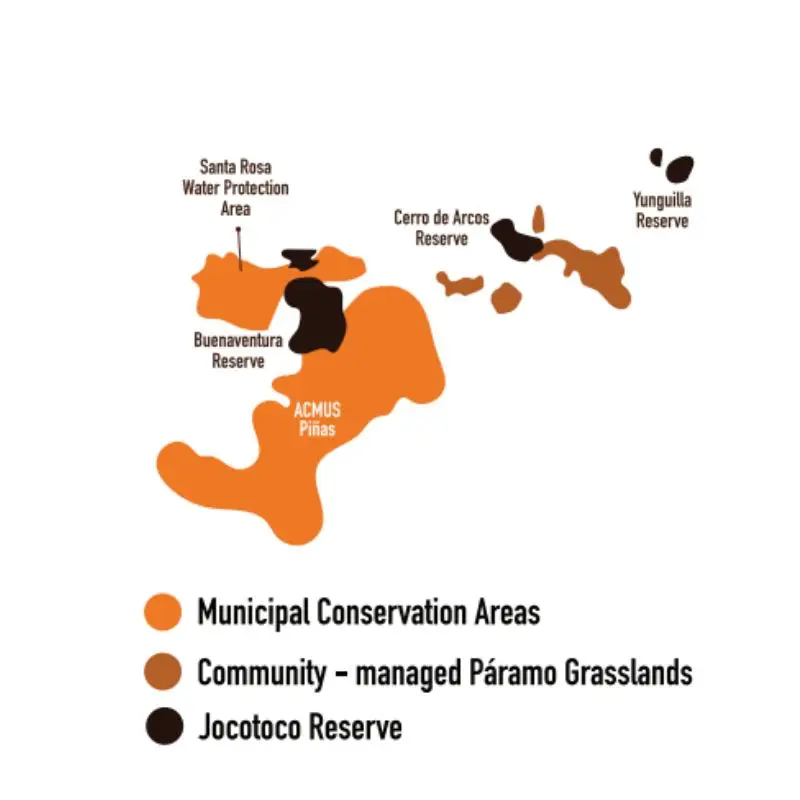
Chumbes map

There are no national parks in this region, so our work here is extremely important. At our Cerro de Arcos Reserve, we protect páramo habitat home to the only population of the Blue-throated Hillstar, a hummingbird discovered recently that only nests in caves. 

After several years of expansion, our Buenaventura Reserve now covers an altitudinal gradient from 1,300 feet (400 m) up to 7,300 feet (2,250 m) in elevation. Why does this matter? The climate is changing. As temperatures warm, species dependent on cool cloud forests move farther up the slope, including the endangered El Oro Parakeet. If we do nothing, these species will run out of habitat. Protecting land at higher elevations throughout Buenaventura is not enough, however. We also must plant the forests of tomorrow. Most of the land in the reserve at higher elevations had previously been cleared for pastures. In the coming years we will reforest this land with tens of thousands of native trees. By acting now, we are restoring the forests that will be the climate refuge for numerous endangered species decades from now. We are preventing the extinction of many rare plants and animals clinging to life at Buenaventura.

At our Buenaventura Reserve, the El Oro Parakeet clings to existence, and is making a comeback. This is thanks to our work not only protecting and restoring its habitat, but also our work placing nesting boxes to emulate tree cavities once abundant in the region`s lost old-growth forests.
The Magnolia Buenaventurensis is an endemic species. It was recently discovered in Ecuador's El Oro Province within our Buenaventura Reserve.
The Blue-throated Hillstar was first discovered in 2017. This hummingbird only inhabits this small area located in the Andean region of southern Ecuador. Its total population was perilously small, estimated to be 80 to 100 individuals. We acted quickly and created the Cerro de Arcos Reserve in 2020 to protect some of its last remaining habitat.

OUR PROGRAMS

Thanks to its strategic location, this area is home to a unique variety of plants and animals that combine species from the Andes and the Amazon. Here, we seek to maintain the connectivity of an entire ladder of ecosystems, from the icy Andean peaks to the jungle of the upper Napo, giving species more space to thrive.
The Podocarpus-El Cóndor Biosphere Reserve hosts a very special assembly of Andean ecosystems, humid forests of the El Cóndor mountain range, older than the Andes, and one of the few dry forests of the Amazon basin trapped between both. Nine of these ecosystems are unique as a whole and all of them are home to countless endemic species. At the same time, destruction due to deforestation and mining is still spreading fast, making our conservation job a high priority if we are to prevent the extinction of hundreds of species, many of them still unknown to science.
Located 600 miles off the coast of Ecuador in the Pacific Ocean, the iconic islands are famed for their biodiversity and have been a living laboratory for the study of evolution for nearly two centuries. The islands are close enough to the mainland that plants and animals have managed to find their way to them. The islands are far enough from the mainland and from each other that once plants and animals arrive, they become isolated and evolve into new and unique species.
The Chocó forests of northwest Ecuador form part of one of the ten most important biodiversity hotspots globally. While the Chocó is almost as diverse as the much better-known Amazon basin, it is far more threatened by rapid deforestation.
This site is registered on wpml.org as a development site. Switch to a production site key to remove this banner.