Our Impact

We now protect and manage a network of reserves covering more than 103,784 acres (42,000 ha), and cooperatively manage an additional 188,000 acres (76,000 ha) of private and communal reserves, totaling an area larger than New York City.
  • In the Pacific Ocean, we helped establish and create a management plan for the massive La Hermandad marine reserve, connecting the Galápagos with Cocos Island in Costa Rica.

  • We’ve planted over 1.7 million trees using 140 native species, restoring tropical forests.

  • In just 25 years, parts of our Canandé Reserve in the Chocó have transformed from barren pastures to lush forests.

Our conservation approach combines advanced science, global collaborations, cutting-edge technology, and strong community engagement.

Science and Innovation

Science is fundamental to conservation success. Improving our data collection and analysis lets us measure our impact. It also lets us test and fix them when needed. We use AI tools to find the species in the reserves and track their populations. We also use the tools to find human-caused threats such as illegal logging or poaching. We use camera traps. We complement them with advanced audio tech. This lets us fully detect threats to biodiversity.

We established the first scientific laboratory in The Chocó and are collaborating with 20 universities to study forest regeneration.
We are saving the Chocó forest, which contains 300 plant species per hectare (2.4 acres), 25% of which are unique.
The Canandé Reserve in the Chocó supports the only healthy population of Jaguars in western Ecuador.
Using AI tools, we've extracted genetic data from 5,000 species of insects in the Choco Láb.
Through sound monitoring, we've identified 60 frog species in the Canandé Reserve.
Each year, between 50 and 100 fledglings of the El Oro Parakeet, successfully emerge from our nest boxes.
We safeguard four species of sea turtles at Las Tunas Beach, releasing 16,000 hatchlings into the sea annually.
We preserve the home of 42 spectacled bears in the Chakana and Tapichalaca reserves.
We successfully reintroduced 23 Great Green Macaws into the wild at the Las Balsas and Ayampe reserves.
More than 3,000 Lilacine Amazons roost in the Algarrobo forest of the Las Balsas Reserve.
Our Chakana Reserve has been designated a "Condor Sanctuary" because it is home to 40 condors, over 30% of Ecuador's total
Against the odds at our Yunguilla Reserve, we made the world's only population of the Pale-headed Brushfinch five times larger in nine years.
Megafauna such as spectacled bears, tapirs, jaguars, and harpy eagles thrive in our reserves, reflecting the success of our conservation efforts.

Boots on the Ground

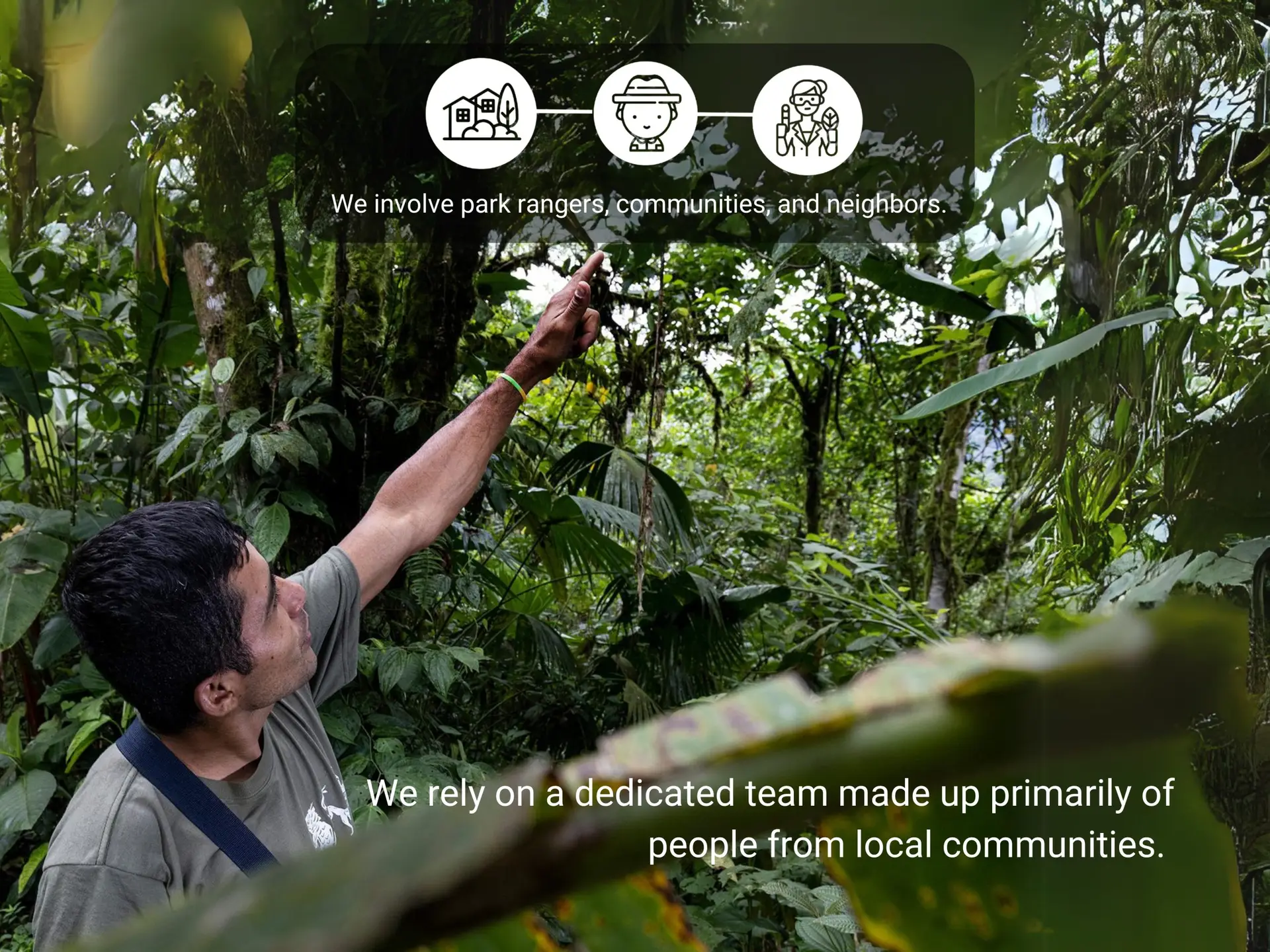
We value our connection to the areas we protect. It’s in our DNA to work “boots on the ground.” Each reserve has park guards who monitor and patrol it and identify and stop illegal incursions. We also assist communities and governments in monitoring and patrolling their properties.
Boots on the Ground

Community Leadership

Conservation is great because we join forces to protect nature and life. Working with communities and organizations is essential because their local perspectives transform us and enrich our strategies.  At the same time, we support the management of their protected areas, strengthen their capacities, and promote economic alternatives that allow them to generate sustainable income while protecting their land and natural resources.

Science is fundamental to conservation success. We collaborate with researchers from across the globe, using state-of-the-art monitoring techniques, Artificial Intelligence, and groundbreaking technology every day.
In The Chocó, we trained 120 cacao producers in sustainable practices, established 4 community nurseries with a capacity of 4,000 plants each, and reforested with 2,000 native trees.
We coordinate with local and national governments.
This site is registered on wpml.org as a development site. Switch to a production site key to remove this banner.