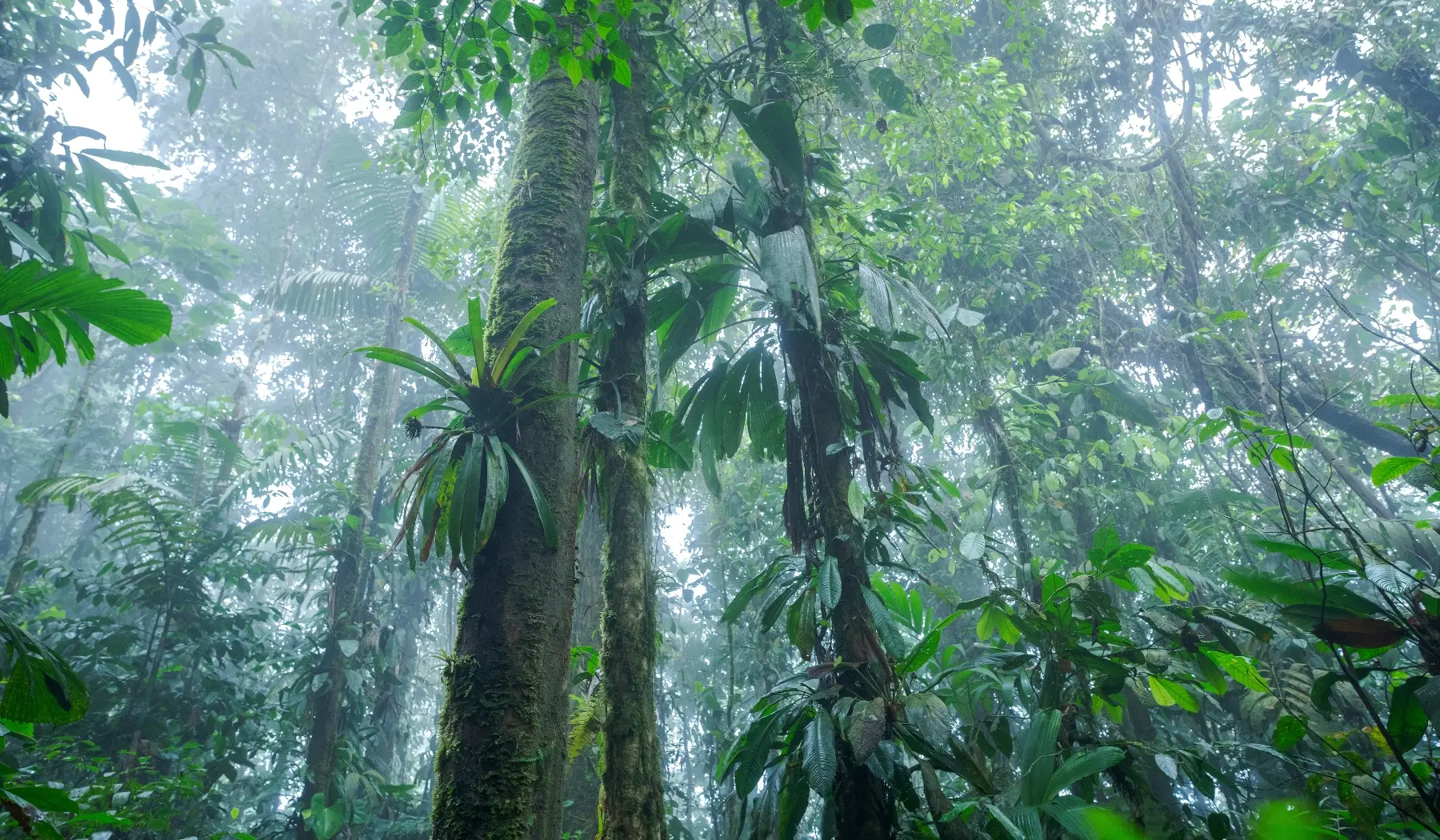

The study presents a high-resolution examination of the ecological recovery of Ecuador’s Chocó rainforests. The researchers utilized advanced technology such as AI, bioacoustic monitoring, and eDNA. They analyzed more than 10,800 species and 23,500 bacterial sequences across 16 taxonomic groups. The research is one of the most comprehensive assessments to date of biodiversity recovery in tropical forests anywhere in the world.
The paper, titled “Biodiversity resilience in a tropical rainforest,” is published in Nature, the world’s leading multidisciplinary science journal. The lead authors, Timo Metz and Nico Blüthgen, developed the study’s concept with Martin Schaefer, CEO of Jocotoco. The study involved more than 30 universities and research centers from Germany, Ecuador, and around the world and was financed by the DFG-funded Research Unit Reassembly.
The research shows that tropical secondary forests regain, on average, more than 90% of species abundance and diversity within 30 years. This means that previously cleared forests recovered 90% of the biomass, the weight of all animals, and 90% of the number of species found in mature forests. Species composition, measured as similarity to old-growth forest, reaches approximately 75% within the same timeframe. While the new mix of species is not yet fully the same as in a mature forest – new species that are typical of secondary forests and edges are now present – 75% of the original species present in an old-growth forest have returned. These forests recovered on their own, without active reforestation, simply by Jocotoco protecting the land. These findings offer hope amid the global biodiversity collapse and demonstrate a roadmap to reverse the rapid decline of wildlife in tropical forests worldwide.
“The study provides the highest level of scientific validation for Jocotoco’s model of conservation. “Martin Schaefer, CEO of Jocotoco says.” By buying and protecting land, Jocotoco preserves the diversity of life and the foundations of our societies – soil, water, and the pollination of the plants that form the basis of our food supply. This study shows how quickly nature can recover on its own, and that we can witness the spectacular return of animals in our lives. The power to restore what we have lost is in our hands.”
The forests in western Ecuador, including the Chocó rainforests, have been decimated by nearly a century of deforestation. Estimates suggest that only 3% of the original forest cover of Western Ecuador remains. Recovering these forests is key to conserving the biodiversity of the Chocó.
“Rainforests, as complex ecosystems and species-rich communities, possess astonishing resilience and the ability to return to their original state. This stability has often been modeled theoretically, but until now it had not been demonstrated on the basis of such a comprehensive dataset.” says Timo Metz, PhD candidate at Technische Universität Darmstadt.
Wildlife is in fact returning to the Canandé Reserve. The critically endangered Horned Marsupial Frog (Gastrotheca cornuta), once thought to be extinct in Ecuador, was rediscovered in the reserve in 2018. Species that had rarely been recorded in western Ecuador, such as the Great Curassow (Crax rubra) and the Giant Anteater (Myrmecophaga tridactyla), are now seen regularly in the reserve. There are more Brown-headed Spider Monkeys of the critically endangered Ecuadorian subspecies than the previous estimate for the entire world population. Two endemic species of magnolia trees are found in the reserve. One of those magnolias, Magnolia dixonii, was downlisted from critically endangered to endangered just last year.
Not only does this study show that natural regeneration of rainforests and the recovery of their biodiversity is possible, it also explains why.
"The many animal species that return quickly are not merely beneficiaries of forest regeneration, but are its key agents: bats, monkeys and other mammals, as well as birds, bring the seeds of trees back to the cleared areas; dung beetles bury the seeds in the soil; and hundreds of other animal species ensure pollination."
Nico Blüthgen, Professor of Ecology at TU Darmstadt and spokesperson for Reassembly.
The study also underscores that full restoration requires sustained protection and long-term conservation. Along with many community partners, Jocotoco is scaling up its conservation work by creating a network of protected areas from lowland Chocó rainforests to high-elevation páramos in the Andes, spanning an altitudinal gradient of nearly 5 km (3 miles). This effort buffers existing protected areas from illegal incursions and connects protected areas together across the landscape. This is creating a positive feedback loop: when ecosystems are more biodiverse and well-connected, they regenerate even faster.
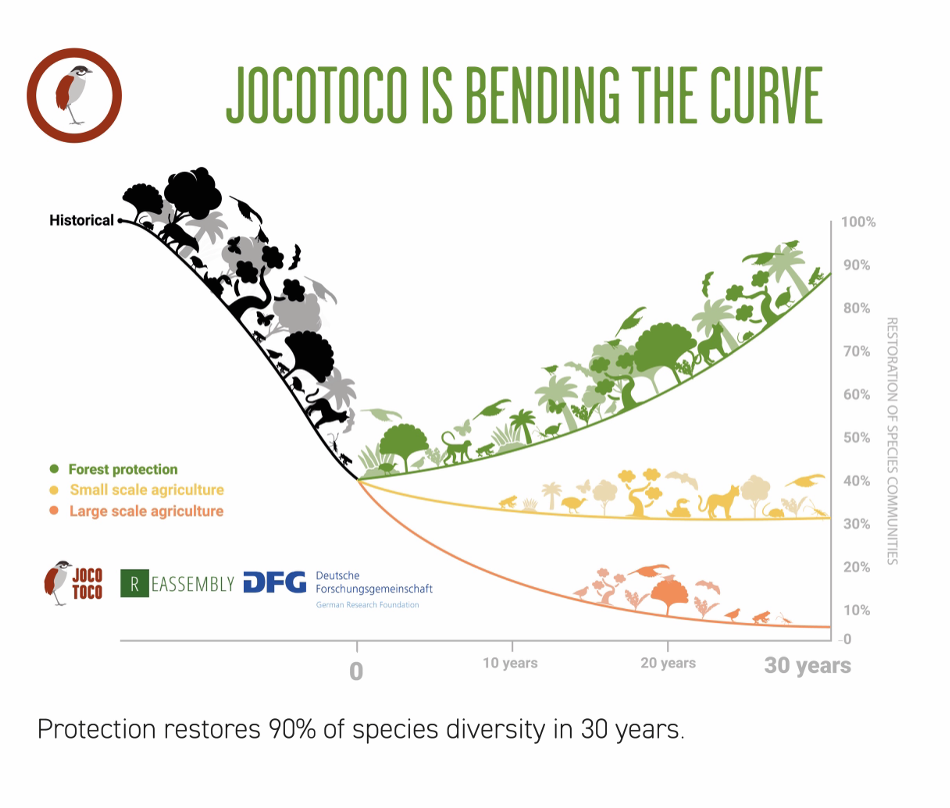
Given that approximately 60% of tropical forests around the world have already been lost or severely degraded, and 70% of remaining tropical forests are secondary forests, these findings have significant implications for global biodiversity conservation. In a world facing accelerating biodiversity loss and climate change, natural regeneration stands out as one of the most scalable, cost-effective, and powerful tools available.
About the study
Published in Nature (2026), the article “Biodiversity resilience in a tropical rainforest” presents one of the most comprehensive assessments to date of biodiversity recovery across multiple trophic levels in tropical forests.
Read the full paper here.
About Reassembly
Reassembly aims at understanding network dynamics to uncover rules of network dis- and reassembly in a highly diverse tropical lowland rainforest ecosystem. We study the dynamics of natural forest recovery from agriculture along a chronosequence and the contribution of re-assembled networks to the resilience of ecosystem processes against perturbation. Our Research Unit is funded by the Deutsche Forschungsgemeinschaft (DFG). (www.reassembly.de)